Will They Ever Open Highway 130 in California Again
| | ||||
|---|---|---|---|---|
| I-680 highlighted in reddish | ||||
| Route data | ||||
| Auxiliary road of I-80 | ||||
| Maintained by Caltrans | ||||
| Length | 70.536 mi[1] (113.517 km) | |||
| History | State highway in 1933; Interstate in 1955 | |||
| Tourist routes |  I-680 between Mission Boulevard (SR 238) in Fremont to SR 24 in Walnut Creek[2] I-680 between Mission Boulevard (SR 238) in Fremont to SR 24 in Walnut Creek[2] | |||
| Major junctions | ||||
| Due south terminate |   I-280 / US 101 in San Jose I-280 / US 101 in San Jose | |||
| Major intersections |
| |||
| North end |   I-80 / SR 12 in Fairfield I-80 / SR 12 in Fairfield | |||
| Location | ||||
| Country | United states | |||
| State | California | |||
| Counties | Santa Clara, Alameda, Contra Costa, Solano | |||
| Highway system | ||||
| ||||
| ||||


 SR 130 in San Jose
 SR 237 in Milpitas
 SR 262 in Fremont
 SR 238 in Fremont
 SR 84 near Sunol
 I-580 on the Dublin / Pleasanton border
 SR 24 in Walnut Creek
 SR 242 about Concord
 SR four in Martinez
 I-780 in Benicia
 I-605
I-605 I-710
I-710Interstate 680 (I-680) is a n–s auxiliary Interstate Highway in Northern California. It curves around the eastern cities of the San Francisco Bay Area from San Jose to Interstate eighty at Fairfield, bypassing cities along the eastern shore of San Francisco Bay such every bit Oakland and Richmond while serving others more inland such as Pleasanton and Hold.
Built in the 1920s and designated in 1955, I-680 begins at a junction with I-280 and US 101 (Bayshore Freeway), and heads northeast and north-northwest through the northeast role of San Jose. Subsequently passing State Route 237 (SR 237) in Milpitas and SR 262 in Fremont, I-680 abruptly turns northeast (where a connection to a SR 238 freeway was planned) and enters the hills and valleys of the California Coast Ranges. The highway crosses over Mission Pass, also known equally the Sunol Grade, and descends into the Sunol Valley, where it meets SR 84 virtually Sunol. From Sunol, I-680 over again heads north-northwesterly through valleys, including the San Ramon Valley, forth the Calaveras Error. Junctions along this portion include I-580 in Dublin and SR 24 in Walnut Creek. Across the latter interchange, a three-way directional junction with the SR 24 freeway west to Oakland, I-680 heads due north into Pleasant Loma, where SR 242 splits and I-680 again heads northwesterly. After the junction with SR 4 in Martinez, the highway crosses the Carquinez Strait on the Benicia-Martinez Bridge, immediately coming together the e end of I-780 on the Benicia end. The remainder of I-680, from Benicia to I-fourscore at Fairfield, lies between a hilly area to the west representing the southwestern tip of the Vaca Mountains, and a marshy area (forth the Suisun Bay and Cordelia Slough) to the east.[3]
Route description [edit]

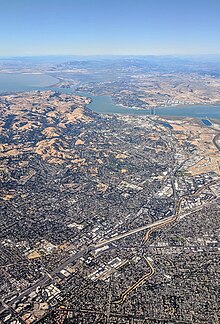
Pleasant Hill, Agree, Martinez, Vallejo aerial looking north, with I-680, the EBMUD Trail, the Walnut Creek, and the bridges over the Carquinez Strait. I-680 roughly parallels the Walnut Creek (the orangish channel) from Walnut Creek, California, to the Carquinez Strait.
The route begins at U.South. Route 101 at the Joe Colla Interchange, where it acts as a continuation of I-280 due east.[4] From here, it begins its journey northward through San Jose, where it meets the Capitol Expressway, signed as CR G21, nearly a mile northeast of I-680'due south southern terminus.[1] The side by side go out northbound is SR 130, which is as well known as Alum Rock Artery, unsigned at the intersection.[5] [6] As information technology continues through Santa Clara Canton, it meets numerous local roads earlier interchanging with the Montague Expressway. Hither, it exits San Jose and enters the city of Milpitas, California, where information technology meets SR 237, often referred to as Calaveras Boulevard. After i more intersection, I-680 exits Santa Clara Canton and enters Alameda County.[1]
In Alameda County, the motorway begins in the city of Fremont, where it intersects SR 262, which was unsigned until 2000. Continuing through the city, it meets Mission Boulevard at SR 238 earlier exiting the city. Prior to 2002, two ghost ramps existed here, remains of an abandoned motorway project replacing Mission Blvd.[i] Amid Alameda Canton, it abruptly turns northeastward and enters a hilly expanse, where it crosses over Mission Pass, and descends into the Sunol Valley, where it runs concurrently with SR 84 for a short while. Afterwards, it enters Pleasanton and intersects with I-580, currently California's longest auxiliary interstate providing admission to Oakland and the Central Valley. It enters Dublin for a short segment before exiting the canton and entering Contra Costa Canton.[1] [four]
Upon inbound Contra Costa Canton, the route meets numerous local roads through the cities of San Ramon, Danville, and Alamo before entering Walnut Creek, where it meets SR 24.[1] I-680 so enters Pleasant Hill for a short time and Concur, where it meets SR 242. Upon exiting Concord, it meets SR 4. Information technology and so enters Martinez, where it follows the Benicia-Martinez Span over the Carquinez Strait, on which the route crosses the county line and enters Benicia in Solano County.[1] [7] [4] On the Benicia-Martinez span I-680 northbound is tolled, while I-680 southbound is free. In Benicia, I-680 interchanges with I-780. It so exits the city and afterward passing through rural areas routing parallel to the San Joaquin Delta, it enters Fairfield, where it meets I-80, which is the route's northern terminus.[4]
In the wake of the September 11 Attacks, a U.Southward. flag was painted on a large piece of concrete on a hill along the Sunol Grade. Information technology stayed there for nine years before Caltrans painted it over, equally the mural had been painted on without authorization.[8] Due to this action beingness taken shortly earlier July 4th, 2010, and also due to the landscape's fame, this was met with controversy. The flag was replaced soon after.
Of the higher up names, only the name Sinclair Freeway for its designated portion usually appears on maps, and the other portions on maps are e'er unnamed, referred to as but I-680.[7]
I-680 is part of the California Freeway and Throughway Organisation,[9] and is part of the National Highway Arrangement,[10] a network of highways that are considered essential to the country's economic system, defense, and mobility by the Federal Highway Assistants.[11] I-680 is eligible to be included in the State Scenic Highway Organization from the Santa Clara–Alameda canton line to SR 24 in Walnut Creek,[12] only is but a scenic route from Mission Boulevard to the Contra Costa county line, and from the Alameda canton line to SR 24;[xiii] this ways that those portions are substantial sections of highway passing through a "memorable landscape" with no "visual intrusions", where the potential designation has gained popular favor with the community.[14]
Express lanes [edit]
A 14-mile (23 km) southbound high-occupancy toll (HOT) lane forth I-680 between SR 84 in Alameda County and through the Sunol Course to SR 237 in Santa Clara Canton opened on September 20, 2010.[15] Northbound HOT lanes along the same stretch opened in October 2022 only initially as HOV Lanes; tolling was halted on this segment of I-680 due to the COVID-19 pandemic and will be resumed in Fall 2021.
HOT lanes also opened in October 2022 in both directions on the portion from slightly south of Alcosta Boulevard nearly the Alameda–Contra Costa line to Rudgear Road in Walnut Creek.[16] On August xx, 2021, the southbound HOT lanes were extended north from Rudgear Road to Marina Vista Boulevard in Martinez.[17]
Equally of Oct 2020[update], the HOT lanes' hours of functioning is weekdays between 5 a.m. and eight p.m. Solo drivers are tolled using a variable pricing arrangement based on the time of twenty-four hours. Carpools, motorcycles, and make clean air vehicles with 2 or more people are not charged. For clean air vehicles with a solo commuter, 50 percent of the posted toll is charged on the Contra Costa Limited Lanes,[xviii] while using the Sunol Express Lanes is free.[19] All tolls are collected using an open road tolling system, and therefore in that location are no toll booths to receive cash. Each vehicle is required to deport either a FasTrak Flex or CAV (Clean Air Vehicle) transponder, with its switch prepare to indicate the number of the vehicle'south occupants (ane, 2, or iii or more than). Solo drivers may too utilise the FasTrak standard tag without the switch.[xviii] [19]
High-occupancy vehicle (HOV) lanes exist from Concord to the Benicia-Martinez Bridge. The HOV lane leading to the Benicia-Martinez Bridge requires a car with 3+ persons, unlike California'due south regular carpool lanes of ii+ persons.[20]
History [edit]

Historic routing [edit]
| Land Route 21 | |
|---|---|
| Location | San Jose - Fairfield |
| Existed | 1934–1976 |

By the 1920s, a road ran s from Martinez through Walnut Creek, Dublin, Danville, and Sunol to Mission San Jose, where it met Land Highway Route 5 (Mission Boulevard, signed over the years as US 48, United states 101E, SR 9, and now SR 238). Information technology was not even so paved due south of Dublin, where it crossed Mission Laissez passer between the Sunol Valley and the San Francisco Bay basin.[vii] The majority of this roadway was added to the thruway organization in 1933 as portions of several routes: Road 108 from Mission San Jose to Sunol, Road 107 from Sunol to Walnut Creek, and Route 75 from Walnut Creek to Pleasant Hill.[21] [22]
At Martinez, the Martinez-Benicia Ferry took automobiles across the Carquinez Strait to Benicia, where Route 7, 1 of the original state highways from the 1910 bond upshot, led due north and northeast past Fairfield towards Sacramento and Oregon.[23] The portion north from Benicia to Fairfield became function of Road 74 in 1935, when Route 7 was realigned to the more straight American Canyon route that is now I-lxxx.[24] None of the aforementioned roads were given land sign route numbers in 1934, when that system was laid out,[25] only by 1937 they had been numbered SR 21.[26] This road began at the intersection of Warm Springs Boulevard and Brown Road in Warm Springs, where Route 5 and Route 69 (SR 17) split, followed Route v along Mission Boulevard to Mission San Jose (this role later became an overlap with SR 9), and then continued to US 40 (Route 7) at Cordelia. The routing was very close to the present I-680, following such roads as Pleasanton Sunol Road, San Ramon Valley Boulevard, Danville Boulevard, Master Street in Walnut Creek, Contra Costa Boulevard, and Pacheco Boulevard.[27]
The portion of SR 21 betwixt Pleasant Hill and Martinez was finally added to the superhighway system in 1949, every bit a branch of Route 75.[28] The ferry approach in Benicia became a spur of Road 74 in 1947,[29] and in 1953 it was transferred to Route 75. The aforementioned police force, effective immediately as an urgency measure, authorized the Section of Public Works to acquire the ferry organization, then operated by the metropolis of Martinez, which was planning to shut it downwardly.[30] Ownership was transferred only after midnight on October half-dozen, 1953.[31]
History as an Interstate [edit]

1955 map of the planned Interstates in the San Francisco Bay Surface area. These early plans essentially called for an interstate loop route that would head due south down the San Francisco Peninsula from San Francisco to San Jose, and then head northward through the eastern cities of the E Bay to Vallejo. This route now basically comprises present-day I-280, I-680, and I-780.
The Bureau of Public Roads canonical urban routes of the Interstate Highway Organization on September fifteen, 1955, including a loop effectually the San Francisco Bay, shortly numbered I-280 and I-680. The eastward half (I-680) began at the interchange of The states 101 n of downtown San Jose and followed the Nimitz Superhighway (SR 17/Road 69, now I-880) to the split at Warm Springs (the present location of SR 262), SR 21 to Benicia, and Road 74 (no sign route number) to I-80 in Vallejo.[32] [33] [34] The starting time piece of I-680 freeway built, other than the pre-existing Nimitz Freeway, was in the late 1950s, along the SR 24 overlap between Northward Principal Street in Walnut Creek and Monument Boulevard in Pleasant Loma.[35] [36] A southerly extension, bypassing downtown Walnut Creek to South Chief Street, opened on March 22, 1960, connecting with the SR 24 expressway to Oakland.[37] In the next decade, the freeway was completed from Vallejo s to SR 238 at Mission San Jose, and the roadway north from Benicia to Fairfield, which became the only remaining piece of SR 21, was besides upgraded to freeway standards.[38] [39]
In the 1964 renumbering, the legislative designation was changed to Road 680. SR 17 was officially moved to former Route 5 between San Jose and Warm Springs, which had non had a signed designation since the Nimitz Thruway (so I-680) was constructed,[xl] but this was instead marked as role of SR 238 (which replaced SR 9 northward of Mission San Jose), and SR 17 remained signed along the Nimitz Freeway.[41] This was very short-lived, as the Bureau of Public Roads approved a shift in the southward end of I-680 in Oct 1964.[33] The legislature changed the routes in 1965, swapping Routes 17 and 680 south of Warm Springs, and creating a new SR 262 on the brusk roadway at Warm Springs where they had overlapped to switch sides.[42] [43] However, until I-680 was completed in the early-to-mid 1970s,[38] it remained signed along the Nimitz Pike, and the erstwhile road betwixt San Jose and Warm Springs continued to be marked equally SR 238.[39] One more change was fabricated to the routing of I-680: in July 1973, the residual of SR 21, from Benicia to Fairfield, was added to the Interstate Highway System. This became the new alignment of I-680, and the old route to Vallejo became I-780. The corresponding changes were made past the land legislature in 1976.[44]
Exit list [edit]
Encounter also [edit]
References [edit]
- ^ a b c d e f g h California Department of Transportation. "State Truck Route List". Sacramento: California Department of Transportation. Archived from the original (XLS file) on June 30, 2015. Retrieved June 30, 2015.
- ^ California Section of Transportation (August 2019). "Officially Designated Country Scenic Highways and Historic Parkways" (XLSX). Sacramento: California Department of Transportation.
- ^ Google Maps street maps and USGS topographic maps, accessed February 2008 via Top Mapper
- ^ a b c d The United states (Map). National Geographic. October 2006.
- ^ "Google Maps". Google Maps . Retrieved 13 April 2018.
- ^ "Google Maps". Google Maps . Retrieved 13 April 2018.
- ^ a b c Rand McNally & Company, San Francisco and Vicinity, 1927
- ^ Berton, Justin (July iii, 2010). "Governor sorry about flag Caltrans painted over". San Francisco Chronicle. Retrieved twenty July 2012.
- ^ "Article 2 of Chapter 2 of Segmentation ane". California Streets and Highways Lawmaking. Sacramento: California Office of Legislative Counsel. Retrieved February half-dozen, 2019.
- ^ Federal Highway Administration (March 25, 2015). National Highway System: California (North) (PDF) (Map). Scale not given. Washington, DC: Federal Highway Administration. Retrieved July 29, 2017.
- ^ Natzke, Stefan; Neathery, Mike & Adderly, Kevin (June xx, 2012). "What is the National Highway System?". National Highway System. Washington, DC: Federal Highway Assistants. Retrieved July 1, 2012.
- ^ "Article 2.five of Chapter two of Segmentation 1". California Streets & Highways Code. Sacramento: California Office of Legislative Counsel. Retrieved February half dozen, 2019.
- ^ California Department of Transportation (Baronial 2019). "Officially Designated State Scenic Highways and Celebrated Parkways" (XLSX). Sacramento: California Department of Transportation. Retrieved July 29, 2017.
- ^ California Department of Transportation (2012). Scenic Highway Guidelines (PDF). Sacramento: California Department of Transportation. p. 5. Retrieved June eight, 2017.
- ^ "I-680 Smart Lane". 680expresslane.org. Retrieved 2013-01-26 .
- ^ "Commuters dislocated virtually new express lanes coming to I-680". KGO-Telly. 2017-ten-05.
- ^ "Southbound I-680 express lane from Martinez to Walnut Creek to begin cost operations Aug. twenty". danvillesanramon.com. 2021-07-25.
- ^ a b "I-680 Contra Costa Limited Lanes". www.bayareafastrak.org. CalTrans. Retrieved 24 Oct 2020.
- ^ a b "I-680 Sunol Express Lanes". world wide web.bayareafastrak.org. CalTrans. Retrieved 24 Oct 2020.
- ^ "High-Occupancy Vehicle (HOV) & Limited Lanes Northern California Region" (PDF). HOV_NorCal.pdf. CalTrans. Retrieved 2 June 2016.
- ^ California State Associates. "An human action to amend sections two, 3 and 5 and to add together two sections to be numbered 6 and 7 to an deed entitled 'An human activity to provide for the acquisition of rights of way for and the construction, maintenance..." Fiftieth Session of the Legislature. Statutes of California. State of California. Ch. 767 p. 2036. : "Pike Route 75 near Walnut Creek to State Highway Route 5 well-nigh Stockton via Antioch." "State Highway Road 75 near Walnut Creek to Livermore-San Jose Mission Route near Scotts Corners." "State Highway Route v near Mission San Jose to Throughway Road 5 almost Livermore."
- ^ California State Assembly. "An human activity to establish a Streets and Highways Code, thereby consolidating and revising the constabulary relating to public means and all appurtenances thereto, and to repeal certain acts and parts of acts specified herein". 50-first Session of the Legislature. Statutes of California. State of California. Ch. 29 p. 281, 283. : "Route 75 is from: (a) Oakland to Route 5 virtually Stockton via Walnut Creek and Antioch..." "Road 107 is from: (a) Road 75 near Walnut Creek to Route 108 near Scotts Corners..." "Route 108 is from Route five near Mission San Jose to Route 5 near Livermore."
- ^ Howe & Peters, Engineers' Study to California State Auto Association Covering the Work of the California Highway Commission for the Flow 1911-1920, pp. eleven-16
- ^ California State Assembly. "An act...relating to State highways". Fifty-beginning Session of the Legislature. Statutes of California. State of California. Ch. 274 p. 959, 281. : "Route 74 is from a betoken on Route viii most the Napa Y to Cordelia via Vallejo and Benicia."
- ^ Dennis, T.H. (August 1934). "Country Routes Will Exist Numbered and Marked with Distinctive Deport Signs". California Highways and Public Works. 11 (8): 20–21, 32. ISSN 0008-1159 – via Archive.org.
- ^ Oakland Tribune, classified ads, August xv, 1937: "one acre on Highway 21, s of Walnut Creek"
- ^ United states Geological Survey, 1942 San Jose, 1940 Livermore, 1942 Mount Diablo, 1941 Concur, 1940 Carquinez Strait (scale 1:62500)
- ^ California State Assembly. "An act...relating to state highway routes". 1949 Session of the Legislature. Statutes of California. Land of California. Ch. 1467 p. 2555. : "Route 75 is from:...(b) Route (a) in a higher place, north of Walnut Creek to Martinez..."
- ^ California Land Assembly. "An human activity to meliorate Section 374 of, and to add Sections 512 and 543 to, the Streets and Highways Code, relating to state highways". L-seventh Session of the Legislature, 1st extraordinary session. Statutes of California. State of California. Ch. 13 p. 3812. : "Route 74 is from:...(b) (a) in a higher place nigh Chiliad and East Second Street to East Fifth and C Streets, in Benicia."
- ^ California Land Assembly. "An act authorizing the conquering by the Department of Public Works of the ferry system across Carquinez Straits betwixt Benicia and Martinez..." 1953 Session of the Legislature. Statutes of California. State of California. Ch. 1737 p. 3486-3488. : "Road 75 is from:...(b) Route (a) above, north of Walnut Creek to a connection with Route 74 in Benicia." [Note that this police accidentally deleted portion (c) of Route 75; an urgency measure out passed at the 1954 1st extraordinary session (chapter 8) corrected this mistake.]
- ^ San Mateo Times, State Ready to Take Over Benicia Ferry, September 29, 1953
- ^ Bureau of Public Roads, General Location of National System of Interstate Highways, 1955: San Francisco
- ^ a b California Department of Transportation, Throughway Routes: Selected Information, 1994 with 1995 revisions, pp. 342, 348
- ^ H.M. Gousha Visitor, California, 1963
- ^ Oakland Tribune, Lafayette Bypass to Slash Travel Time for Commuters, September nine, 1956: "With some other superhighway link now nether construction due north from Walnut Creek to the Monument..."
- ^ United States Geological Survey, Walnut Creek (scale 1:24000), 1959
- ^ Oakland Tribune, Ceremony Salutes New Freeway Link, March 23, 1960
- ^ a b c California Department of Transportation (July 2007). "Log of Bridges on State Highways". Sacramento: California Department of Transportation.
- ^ a b H.M. Gousha Company, San Francisco, 1968
- ^ California Land Associates. "An act to add Department 253 and Article 3 (commencing with Section 300) to Chapter ii of Segmentation i of, and to repeal Section 253 and Article 3 (commencing with Section 300) of Chapter ii of Division 1 of, the..." 1963 Session of the Legislature. Statutes of California. State of California. Ch. 385 p. 1173, 1189. : "Route 17 is from: (a) Route 1 nearly Santa Cruz to Route 101 most Story Road. (b) Route 101 near San Jose to Route 680 near Warm Springs. (c) Route 680 near Warm Springs to Route 580 in Oakland..." "Route 680 is from Route 280 in San Jose to Road 80 in Vallejo passing almost Warm Springs, Mission San Jose, Scotts Corners and Sunol, and via Walnut Creek and Benicia."
- ^ Oakland Tribune, Highway 9 Has a New Number, April 19, 1964
- ^ California State Assembly. "An act...relating to land highways". 1965 Session of the Legislature. Statutes of California. Land of California. Ch. 1371 p. 3268, 3269. : "Route 262 is from Route 17 to Route 680 most Warm Springs." "Route 680 is from Route 101 near San Jose to Route 80 in Vallejo passing almost Warm Springs, Mission San Jose, Scotts Corners and Sunol, and via Walnut Creek and Benicia."
- ^ California State Assembly. "An human action to ameliorate Sections 253, 307, 317, 322, 334, 342, 347, 349, 361, 363, 372, 373, 374, 379, 384, 390, 407, 408, 443, 455, 470, 486, 514, 517, 548, and 550 of, to add Sections 556, 557, 558, 560..." 1965 Session of the Legislature. Statutes of California. Country of California. Ch. 1372 p. 3273. : "Route 17 is from: (a) Route 1 nearly Santa Cruz to Route fourscore in Oakland..."
- ^ California State Assembly. "An deed to amend Sections 143.2, 186, 253.1, 253.2, 253.4, 253.v, 253.6, 263.ane, 263.5, 263.seven, 311, 312, 333, 360, 374, 375, 378, 381, 384, 388, 411, 417, 422, 440, 441, 460, 506, 559, 563, 582, and 620 of, to add..." 1975–1976 Session of the Legislature. Statutes of California. Country of California. Ch. 1354 p. 6176, 6178. : "Road 680 is from: (a) Route 101 near San Jose to Road 780 at Benicia passing near Warm Springs, Mission San Jose, Scotts Corners, and Sunol, and via Walnut Creek. (b) Road 780 at Benicia to Road 80 near Cordelia." "Road 780 is from Route 680 at Benicia to Route lxxx in Vallejo."
- ^ a b "Interstate 680 Freeway Interchanges" (PDF). California Numbered Exit Uniform Arrangement. California Section of Transportation. September 7, 2018. Retrieved Oct 21, 2020.
- ^ California Section of Transportation, All Traffic Volumes on CSHS, 2005 and 2006
External links [edit]
Road map:
KML is from Wikidata
- Bay Area FasTrak – includes toll information on the I-680 Limited Lanes, the Benicia–Martinez Span, and the other Bay Area toll facilities
- California Highways: Interstate 680
- California @ AARoads.com - I-680
- Caltrans: Road 680 highway weather condition
Source: https://en.wikipedia.org/wiki/Interstate_680_(California)
0 Response to "Will They Ever Open Highway 130 in California Again"
Post a Comment