The Act of Making Complete Again
4.4 Stages of Listening
Learning Objectives
- Explicate the receiving stage of listening.
- Explain the understanding stage of listening.
- Explain the remembering phase of listening.
- Explain the evaluating stage of listening.
- Explicate the responding stage of listening.
- Empathize the two types of feedback listeners give to speakers.
Figure 4.3 Stages of Feedback
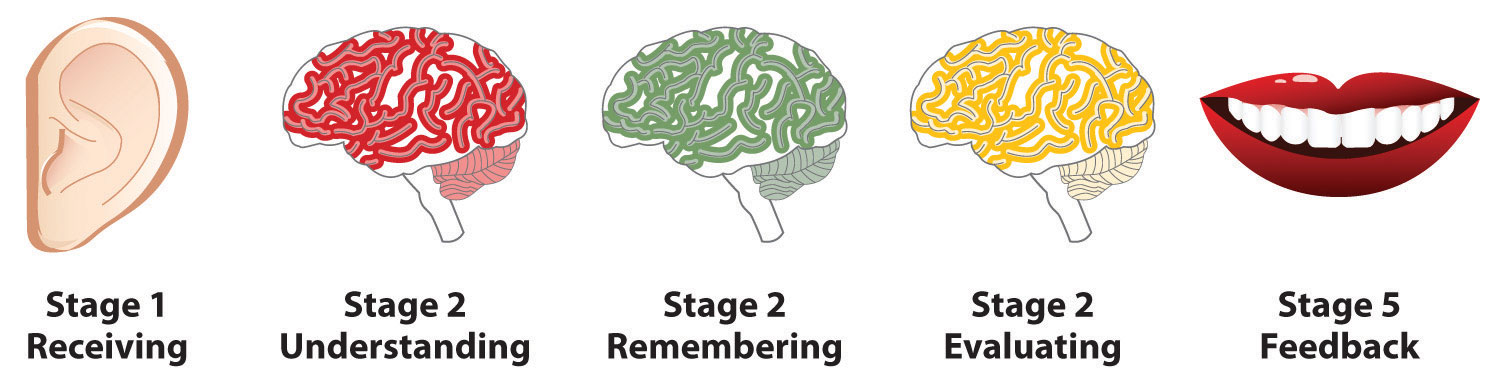
Every bit you read earlier, there are many factors that can interfere with listening, so you need to exist able to manage a number of mental tasks at the aforementioned time in society to be a successful listener. Author Joseph DeVito has divided the listening process into five stages: receiving, understanding, remembering, evaluating, and responding.DeVito, J. A. (2000). The elements of public speaking (7th ed.). New York, NY: Longman.
Receiving
ReceivingThe procedure of hearing and giving focused attention to a speaker's bulletin. is the intentional focus on hearing a speaker'due south bulletin, which happens when we filter out other sources so that nosotros can isolate the message and avoid the disruptive mixture of incoming stimuli. At this stage, we are still only hearing the message. Notice in Figure 4.three "Stages of Feedback" that this phase is represented by the ear considering information technology is the principal tool involved with this stage of the listening process.
One of the authors of this volume recalls attending a political rally for a presidential candidate at which well-nigh v thou people were crowded into an outdoor amphitheater. When the candidate finally started speaking, the auspicious and yelling was so loud that the candidate couldn't be heard hands despite using a speaker organisation. In this example, our coauthor had difficulty receiving the message because of the external noise. This is only one example of the means that hearing lonely can crave sincere effort, but you must hear the bulletin earlier you can proceed the process of listening.
Understanding
In the understandingThe attempt to larn the speaker's meanings. stage, we attempt to learn the meaning of the message, which is not always easy. For one affair, if a speaker does non enunciate clearly, it may be difficult to tell what the message was—did your friend say, "I remember she'll exist late for course," or "my instructor delayed the class"? Detect in Figure four.3 "Stages of Feedback" that stages ii, three, and four are represented by the brain because it is the chief tool involved with these stages of the listening process.
Fifty-fifty when we take understood the words in a message, considering of the differences in our backgrounds and experience, we sometimes brand the mistake of attaching our own meanings to the words of others. For example, say you lot have made plans with your friends to see at a certain movie theater, only y'all arrive and nobody else shows up. Eventually you find out that your friends are at a different theater all the way across town where the same movie is playing. Anybody else understood that the meeting place was the "west side" location, only you wrongly understood it every bit the "east side" location and therefore missed out on role of the fun.
The consequences of ineffective listening in a classroom can be much worse. When your professor advises students to become an "early start" on your spoken communication, he or she probably hopes that you volition begin your research correct away and move on to developing a thesis argument and outlining the speech as soon as possible. However, students in your grade might misunderstand the teacher's meaning in several ways. One student might translate the advice to mean that as long as she gets started, the residue of the assignment will have time to develop itself. Another student might instead call up that to start early on is to start on the Friday before the Mon due engagement instead of Sunday dark.
And then much of the way we empathize others is influenced by our ain perceptions and experiences. Therefore, at the understanding stage of listening we should be on the lookout for places where our perceptions might differ from those of the speaker.
Remembering
RememberingThe ability to recall accurately the content of a message. begins with listening; if you can't remember something that was said, y'all might non accept been listening effectively. Wolvin and Coakley note that the near common reason for not remembering a message after the fact is because it wasn't actually learned in the first place.Wolvin, A., & Coakley, C. G. (1996). Listening (5th ed.). Boston, MA: McGraw-Loma. Notwithstanding, even when y'all are listening attentively, some letters are more difficult than others to understand and remember. Highly complex messages that are filled with particular call for highly developed listening skills. Moreover, if something distracts your attention even for a moment, you could miss out on information that explains other new concepts you hear when yous begin to mind fully again.
It'south too of import to know that yous can ameliorate your memory of a message past processing it meaningfully—that is, past applying it in ways that are meaningful to you. Gluck, M. A., Mercado, E., & Myers, C. Due east. (2008). Learning and retention: From brain to behavior. New York: Worth Publishers, pp. 172–173. Instead of simply repeating a new acquaintance's proper noun over and over, for case, y'all might remember it by associating it with something in your ain life. "Emily," you might say, "reminds me of the Emily I knew in middle schoolhouse," or "Mr. Impiari'southward name reminds me of the Impala my begetter drives."
Finally, if understanding has been inaccurate, recollection of the message will be inaccurate too.
Evaluating
The fourth stage in the listening process is evaluatingThe listener's process of judging the value of a message or a speaker. , or judging the value of the message. We might be thinking, "This makes sense" or, conversely, "This is very odd." Because everyone embodies biases and perspectives learned from widely diverse sets of life experiences, evaluations of the same message tin vary widely from i listener to another. Even the most open-minded listeners will have opinions of a speaker, and those opinions volition influence how the bulletin is evaluated. People are more likely to evaluate a bulletin positively if the speaker speaks conspicuously, presents ideas logically, and gives reasons to back up the points made.
Unfortunately, personal opinions sometimes result in prejudiced evaluations. Imagine you're listening to a speech given by someone from another country and this person has an accent that is hard to empathize. You may have a hard time merely making out the speaker'due south message. Some people find a foreign emphasis to be interesting or even exotic, while others find it annoying or fifty-fifty take information technology equally a sign of ignorance. If a listener has a potent bias against strange accents, the listener may not even attempt to attend to the bulletin. If you lot mistrust a speaker considering of an accent, you could be rejecting important or personally enriching information. Good listeners have learned to refrain from making these judgments and instead to focus on the speaker'due south meanings.
Responding
RespondingThe verbal and nonverbal feedback given by listeners during and after the presentation of a message. —sometimes referred to equally feedback—is the 5th and final phase of the listening process. It'south the stage at which you indicate your involvement. Almost anything y'all do at this phase can be interpreted as feedback. For instance, you lot are giving positive feedback to your instructor if at the end of class you stay behind to finish a sentence in your notes or approach the teacher to enquire for clarification. The opposite kind of feedback is given by students who gather their belongings and rush out the door as soon equally class is over. Notice in Figure four.3 "Stages of Feedback" that this stage is represented by the lips considering we frequently give feedback in the form of verbal feedback; withal, y'all can simply as easily respond nonverbally.
Determinative Feedback
Non all response occurs at the end of the message. Formative feedback is a natural office of the ongoing transaction between a speaker and a listener. Equally the speaker delivers the message, a listener signals his or her involvement with focused attending, note-taking, nodding, and other behaviors that indicate agreement or failure to empathise the message. These signals are of import to the speaker, who is interested in whether the message is clear and accustomed or whether the content of the message is meeting the resistance of preconceived ideas. Speakers can use this feedback to decide whether additional examples, support materials, or explanation is needed.
Summative Feedback
Summative feedback is given at the cease of the communication. When y'all attend a political rally, a presentation given by a speaker you admire, or even a form, there are verbal and nonverbal means of indicating your appreciation for or your disagreement with the messages or the speakers at the terminate of the bulletin. Perhaps you'll stand up and applaud a speaker you agreed with or just sit down staring in silence afterward listening to a speaker you didn't like. In other cases, a speaker may be attempting to persuade you lot to donate to a charity, so if the speaker passes a bucket and you make a donation, you lot are providing feedback on the speaker'south effectiveness. At the same time, nosotros practise not always mind most carefully to the letters of speakers nosotros admire. Sometimes we simply bask existence in their presence, and our summative feedback is not most the message but nigh our attitudes about the speaker. If your feedback is limited to something like, "I only love your vocalization," you might be indicating that you did non mind carefully to the content of the message.
There is little dubiety that by now, you lot are outset to empathise the complexity of listening and the great potential for errors. By condign aware of what is involved with active listening and where difficulties might prevarication, you lot can prepare yourself both as a listener and as a speaker to minimize listening errors with your own public speeches.
Central Takeaways
- The receiving stage of listening is the basic stage where an private hears a message existence sent by a speaker.
- The understanding phase of listening occurs when a receiver of a bulletin attempts to figure out the significant of the message.
- The remembering phase of listening is when a listener either places data into long-term memory or forgets the information presented.
- The evaluating stage of listening occurs when a listener judges the content of the bulletin or the character of the speaker.
- The responding phase of listening occurs when a listener provides verbal or nonverbal feedback about the speaker or message.
- During the responding stage of listening, listeners tin provide speakers with two types of feedback designed to help a speaker know whether a listener is understanding and what the listener thinks of a message. Formative feedback is given while the speaker is engaged in the act of speech making. Summative feedback is given at the conclusion of a speech.
Exercises
- Brand a listing of some of the abstract words you lot have misunderstood. What were the consequences of the misunderstanding?
- Reverberate on your listening in grade or in other settings where remembering information is important. What keeps you from remembering of import data accurately?
- Requite an instance of a time when you felt that your message was misunderstood or treated with shallow attention. How did you lot know your bulletin had been misunderstood or rejected? What does this mean you must practice as a educatee of public speaking?
Source: https://saylordotorg.github.io/text_stand-up-speak-out-the-practice-and-ethics-of-public-speaking/s07-04-stages-of-listening.html
0 Response to "The Act of Making Complete Again"
Post a Comment